
From Software to Diagnostic Assay: Rethinking AI in Pathology from the Laboratory

When artificial intelligence first began to enter pathology laboratories, many of us experienced it as a technical promise. Greater speed. Increased efficiency. Expanded analytical capacity. Over time, however, it became clear that the main barrier to adoption was not technological, but conceptual. We were not failing to train models. We were failing to understand what, exactly, we were introducing into the diagnostic act.
Today, in most hospital environments, AI is still treated as software. It is grouped alongside laboratory information systems (LIS), image management platforms (PACS), or other IT tools, and evaluated using metrics borrowed from information technology: server uptime, interface stability, loading times. Within this framework, for an AI system to “work” simply means that it does not crash.
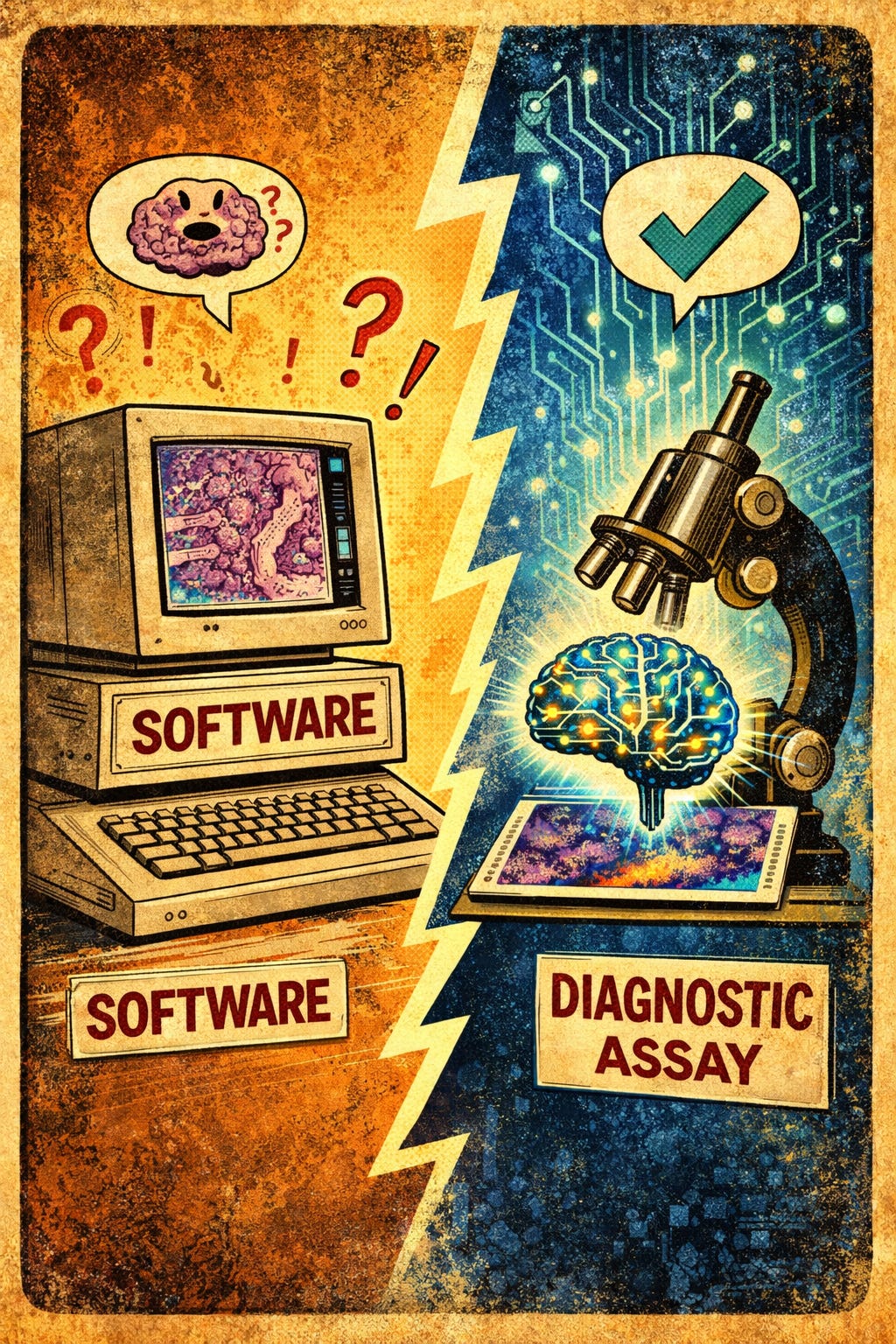
This way of thinking is profoundly inadequate for clinical practice. An algorithm designed to detect metastatic disease in a lymph node is not an administrative productivity tool. It is a diagnostic assay. It performs the same fundamental function we have relied on for decades: it interacts with a biological substrate and produces a signal that informs a medical decision.
From this perspective, the distance between a deep learning model and an immunohistochemical antibody is far smaller than we usually acknowledge. Both have sensitivity and specificity. Both have limits of detection. Both are vulnerable to analytical interference. And, critically, both can generate results that appear convincing yet are clinically wrong when used outside the conditions for which they were validated.
The difference is cultural. With traditional laboratory reagents, validation, quality control, and ongoing surveillance are taken for granted. With AI, we too often place our trust in the mere fact that the model has already been trained.
Reframing AI as a computational reagent fundamentally changes the rules. It is no longer sufficient for a system to simply produce an output. That output must be analytically valid, clinically interpretable, and generated within a clearly defined operational envelope. And when that envelope is violated, the system must be capable of signaling it.
This article is built around a simple but uncomfortable idea: if AI is to become a trustworthy tool in pathology, we must stop treating it as software and start managing it for what it truly is, a diagnostic assay that demands the same level of rigor as any other method we use to make decisions about patients.
The Conceptual Framework of the Computational Reagent

To integrate artificial intelligence safely into pathology, technical robustness alone is not sufficient. What is required is a deeper shift, almost cultural in nature. We must move away from the mindset of consumer software and adopt the same rigor with which, as pathologists, we evaluate any diagnostic assay that influences clinical decision-making.
This shift is not merely semantic. It implies acknowledging that AI actively participates in the diagnostic act and therefore must be subject to the same requirements for characterization, validation, and control as any other test used in the laboratory.
Definition and Properties of the Computational Reagent
The concept of a computational reagent (1) refers to an encapsulated AI model, typically a convolutional neural network with frozen weights, that interacts with a digitized biological substrate, the whole-slide image, to produce a measurable reaction. This reaction may take the form of a probability score, a binary classification, or a segmentation map that guides the pathologist’s attention.
From this perspective, the parallel with traditional laboratory reagents is immediate. Like an antibody or a chemical reagent, a computational reagent possesses intrinsic properties that cannot be assumed and must be explicitly characterized:
Affinity and avidity: translated algorithmically into the model’s ability to recognize relevant morphological patterns, such as nuclear atypia or glandular architecture, even in the presence of histological noise.
Analytical specificity: the capacity to distinguish the analyte of interest, for example tumor cells, from frequent morphological mimickers such as histiocytes, activated lymphocytes, or technical artifacts (2).
Stability: while traditional reagents degrade over time or due to storage conditions, computational reagents are affected by a less intuitive phenomenon, algorithmic drift. Even if the model itself does not change, its environment does. New scanners, adjustments in staining protocols, or subtle technical modifications can progressively erode performance (3).
Recognizing these properties allows us to move beyond viewing AI as an abstract black box and begin managing it for what it truly is: a living component of the diagnostic system.
The Operational Envelope and Intended Use
In high-criticality engineering domains, such as aviation, no system is operated outside a clearly defined operational envelope (4). The same principle applies to digital pathology, even if it is not always stated explicitly. An algorithm’s operational envelope is defined by the specific conditions under which it was trained and validated.
From a regulatory standpoint, this principle is formalized through the concept of Intended Use. An AI system is not simply a “cancer detector.” Safe use depends on a precise definition of context. At a minimum, this includes:
The target population: for example, prostate core needle biopsies versus transurethral resections (5).
The intended user: a general pathologist or a subspecialist, and whether the tool is used as a triage mechanism or as a second reader.
The technical environment: compatible scanners, staining protocols, and magnification levels for which performance has been established (6).
When this operational envelope is ignored, risks inevitably emerge. Applying an algorithm trained on prostate biopsies to a bone metastasis of prostate cancer, with a completely different marrow background, constitutes a high-risk off-label use. This situation is analogous to applying a clinical chemistry assay to a type of biological sample for which it was never designed or validated.
The Risk of Silent Failure
One of the most delicate aspects of computational reagents is that they do not always fail visibly. Unlike traditional software, which typically stops or generates an error message, AI systems can function perfectly from a technical standpoint while producing a clinically incorrect result. This phenomenon is referred to as silent failure (2).
Such failures are often linked to the learning of shortcuts during model training. It has been shown that deep learning models may base their predictions on spurious correlations, such as marker pen annotations, coverslip edges, or subtle staining variations, rather than on the underlying tissue biology (7). When these signals change or disappear, the model may “hallucinate” a diagnosis without any external indication of error.
Managing this risk requires going beyond average performance metrics. It calls for interpretability tools and uncertainty estimation mechanisms capable of identifying samples that fall outside the training distribution (out-of-distribution) (8). Only then can pathologists and patients be adequately protected, by signaling when an algorithmic output should be interpreted with caution or disregarded altogether.
The Digital Substrate and Pre-Analytical Variables

In the wet laboratory, the principle of “Garbage In, Garbage Out” is unquestionable. A poorly fixed, hemolyzed, or degraded specimen compromises any downstream analytical result. In digital pathology, this principle still applies, but with a fundamental difference: the algorithm’s input material is not the tissue itself, but its digital representation.
The whole-slide image (WSI) is not a neutral reflection of the tissue. It is the result of a chain of physical, optical, and computational transformations that introduce their own pre-analytical variables, variables that can significantly interfere with the performance of the computational reagent.
Scanner Variability
Digitization is not a passive process, different whole-slide scanners rely on different sensors (CCD versus CMOS), illumination systems (LED versus halogen), and optical configurations with varying numerical apertures (9). Added to this is a less visible but critical factor: each manufacturer applies proprietary image signal processing (ISP) algorithms for color reconstruction, white balance, and sharpening (10).
Recent studies have shown that this inter-scanner variability can induce a substantial batch effect (10). An AI model trained exclusively on images from a single scanner may experience marked drops in performance when confronted with images generated by a different device, even when the underlying tissue is identical. The reason is that the model learns pixel-level textures and color patterns that are imperceptible to the human eye but specific to the acquisition hardware (18).
From an operational standpoint, the implication is clear: validation of an AI algorithm must, by definition, be scanner-specific, or explicitly demonstrate scanner agnosticism through rigorous equivalence testing. Introducing a new scanner into the laboratory is not a purely logistical change. It requires a bridging study to confirm that the computational reagent maintains its performance under the new acquisition conditions (12).
Staining Variability and Color Normalization
Variability in hematoxylin and eosin staining is a well-recognized source of pre-analytical noise. Factors such as reagent brand, incubation times, wash water pH, or section thickness can substantially alter the chromatic appearance of tissue (13).
To mitigate this variability, stain normalization techniques have been developed. These methods aim to align the color characteristics of an image with a standardized reference and act as a preprocessing step before the image is analyzed by the model(13).
Classical approaches, based on color deconvolution or histogram matching, are computationally efficient but may introduce artifacts when the original staining is highly aberrant. In parallel, more advanced methods based on generative adversarial networks (GANs) have emerged, enabling virtual “restaining” of an image to match the style of a reference laboratory (14).
However, this apparent solution introduces a new clinical risk. Poorly applied normalization can erase subtle nuclear details, alter chromatin texture, or generate artificial edges that interfere with diagnostic interpretation. For this reason, the normalization module cannot be considered a simple interchangeable technical step. It must be regarded as an integral part of the AI device, and any modification requires revalidation (15).
An even more radical approach is computational staining, in which images of unstained tissue are used to generate a virtual H&E image through AI (16). This strategy eliminates chemical variability entirely but introduces a complete dependence on the fidelity with which the AI reconstructs histological information.
Digital Image Quality Control
The digital pre-analytical phase requires dedicated quality control mechanisms. It is not realistic to expect a pathologist to manually assess focus, sharpness, or artifacts across images containing billions of pixels.
As a result, image quality control algorithms are being developed to act as upstream gatekeepers before diagnostic analysis. These systems can identify blurred scans, excessive tissue folds, stitching errors, and other technical defects, and prevent such images from entering the AI workflow.
From a clinical perspective, these filters are not optional. They constitute an essential protective layer to preserve the integrity of the computational diagnostic assay. By ensuring that the computational reagent interacts only with a digital substrate that meets minimum quality standards, they substantially reduce the risk of misleading results (17).
Analytical and Clinical Validation: The Gold Standard
The transition from a research model to a clinical tool does not occur spontaneously. It requires a formal validation process that objectively demonstrates that the system measures what it is intended to measure and that its use provides real value to the diagnostic act. In digital pathology, this step is critical, as it marks the boundary between experimentation and responsible clinical practice.
In the absence of an ISO standard specifically dedicated to artificial intelligence in pathology, the guidelines of the College of American Pathologists (CAP) have become the operational reference framework (18). These guidelines translate long-established principles of laboratory-developed test validation to AI, adapting them to the context of digital imaging.
Validation Principles According to the CAP
The CAP states that AI algorithms must be validated according to the same principles as any other diagnostic system used in the laboratory. While AI-specific recommendations continue to evolve, the Whole Slide Imaging validation guidelines and their subsequent updates provide a solid and widely accepted foundation (18).
A central element is the minimum size of the validation set. For a given clinical application, such as the detection of metastases in a lymph node, a validation set of at least 60 cases is recommended. This number is not arbitrary. It is designed to provide a statistically meaningful confidence interval, typically 95%, and to enable the detection of systematic failures.
Validation, however, is not only about numbers. The disease spectrum represented in those cases is equally important. A validation set composed solely of obvious positives creates a false sense of security. For this reason, the validation cohort must include:
Normal negative cases.
Negative cases with benign conditions that mimic malignancy.
Low-grade and high-grade positive cases.
Rare variants and cases with technical artifacts (18).
In addition, validation must be performed under conditions that reflect real-world practice. Not on isolated servers with “clean” images, but within the actual clinical workflow, including bubbles under the coverslip, marking ink, thick sections, and other common sources of diagnostic noise.
Analytical Versus Clinical Validation
A key point, often overlooked, is the distinction between analytical validation and clinical validation. Both are necessary, but they answer different questions.
Analytical validation focuses on whether the algorithm measures the signal reliably and reproducibly. It evaluates parameters such as repeatability on the same scanner, reproducibility across scanners, limit of detection, and robustness to noise or minor technical variations (19).
Clinical validation, in contrast, asks whether the algorithm’s output correlates with the correct pathological diagnosis and whether its use improves diagnostic performance. This involves metrics such as diagnostic sensitivity and specificity, positive and negative predictive values, and the area under the ROC curve relative to a reference standard (5).
Confusing these two levels of validation can lead to misinterpretation. An algorithm may be analytically consistent yet fail to deliver meaningful clinical impact.
The Challenge of “Ground Truth” in Pathology
Pathology presents a unique epistemological challenge: the so-called gold standard is often based on expert human interpretation. And even among experienced pathologists, interobserver variability exists.
Training and validating an AI model using annotations from a single pathologist carries the risk of encoding individual biases into the system. To mitigate this limitation, several complementary strategies have been proposed:
Consensus panels, using diagnoses agreed upon by multiple subspecialists as ground truth (14).
Orthogonal validation, relying on independent techniques such as immunohistochemistry or molecular assays to confirm morphological diagnoses (20).
Outcome-based validation, correlating algorithm outputs with objective clinical endpoints such as survival or treatment response, thereby reducing reliance on subjective interpretation (21).
These approaches do not eliminate uncertainty entirely, but they enable a more robust and clinically meaningful approximation of ground truth.
Risk Management and Algorithmic Surveillance
Once validated and integrated into the workflow, the computational reagent enters its most critical phase: routine use. This is where many AI projects fail silently. Not because the model suddenly stops working, but because its performance gradually degrades without the system or the user being fully aware of it.
Unlike traditional reagents, whose deterioration is often visible or predictable, AI systems may continue to produce plausible outputs while progressively drifting away from the conditions under which they were validated. For this reason, the clinical deployment of AI requires an explicit strategy for risk management and continuous surveillance, comparable to the technovigilance applied to other medical devices.
The Predetermined Change Control Plan (PCCP)
The iterative nature of AI introduces a specific regulatory challenge. Models can be updated, retrained, or adapted to new data with relative ease, yet each modification has the potential to alter diagnostic behavior.
To address this issue, the Food and Drug Administration (FDA) has introduced the concept of the Predetermined Change Control Plan (PCCP) (22). This framework allows developers to define in advance how and under which conditions an algorithm may be modified without compromising clinical safety.
The PCCP essentially specifies two key elements:
Anticipated modifications: what aspects of the algorithm are expected to change, such as periodic retraining with new data or adaptation to additional scanners.
Associated validation protocol: how it will be demonstrated that these modifications do not degrade clinical performance, typically through non-inferiority testing on a reserved test dataset.
From the clinical laboratory perspective, this means accepting that the version of the algorithm used today will not necessarily be the same one used six or twelve months from now. Laboratories must therefore require transparent access to PCCP documentation and to the results of bridging studies performed after each update, before approving deployment into routine practice (23).
Statistical Process Control and Levey–Jennings Charts
Digital pathology can directly benefit from classical quality control tools used in the clinical laboratory. Among them, statistical process control (SPC) provides a robust framework for monitoring algorithm behavior over time (24).
A practical implementation involves generating Levey–Jennings charts using aggregated algorithm metrics, such as daily positivity rates or the distribution of confidence scores. Continuous monitoring of these metrics enables detection of subtle deviations that may not be apparent at the level of individual cases.
For example, a sudden and sustained increase in breast cancer positivity rates exceeding two standard deviations above the historical mean is unlikely to reflect a true epidemiological shift. Much more plausibly, it indicates a technical issue, such as a change in staining intensity, scanner calibration drift, or an unreported modification of the software environment (25).
When classical quality control rules, such as Westgard rules, are violated, the response should mirror that of the wet laboratory: halt analysis, investigate the root cause, and correct the issue before resuming clinical use of the algorithm.
Monitoring Agents and Stop Rules
In more advanced systems, surveillance does not rely solely on the primary diagnostic algorithm. Independent monitoring agents are deployed to assess prediction uncertainty and consistency in real time (26).
These agents enable the definition of automated stop rules. If the model exhibits high uncertainty in a critical region of the image, or if a case falls outside the training distribution, the system should refrain from providing a diagnostic suggestion and instead force a full manual review (27).
This approach transforms a potentially catastrophic error into a safe failure. Rather than nudging the pathologist toward an incorrect result with unwarranted confidence, the system acknowledges its own limitations and returns control to expert human judgment. Ultimately, this design strengthens trust in AI tools by making clear not only when they can assist, but also when they should not.
Operationalization in the Clinical Laboratory
The successful adoption of artificial intelligence in pathology is not achieved through algorithmic validation alone. Even the most rigorously characterized computational reagents can fail if they are not properly integrated into real laboratory processes. Operationalization is therefore a critical phase that requires a deliberate reengineering of workflows, professional roles, and change management strategies.
Integration Through Middleware and Workflows
AI should not function as a technological island disconnected from the laboratory ecosystem. To deliver real clinical value, it must be seamlessly integrated with the laboratory information system and the digital pathology viewer. This integration is typically achieved through specialized middleware (26).
Middleware acts as the conductor of the digital diagnostic process. Its key functions include:
Automatically routing images to the appropriate algorithm based on sample type, barcode information, or clinical indication.
Receiving and structuring AI-generated outputs (for example, in JSON or XML format).
Deciding whether results can be displayed to the pathologist or must be blocked when quality criteria or stop rules are violated.
Prioritizing the worklist (worklist triage), placing urgent or high-probability positive cases at the top (28).
Without this orchestration layer, AI risks becoming a parallel tool, used inconsistently and without systematic control.
An Emerging Role: The Digital Pathology Technologist
Sustained AI deployment creates the need for hybrid professional profiles. This has led to the emergence of the digital pathology technologist, a role that combines histological expertise with competencies in information technology .
This professional is responsible for, among other tasks:
Daily quality control of scanners.
Monitoring AI analysis queues.
Early detection of technical anomalies or signals of algorithmic drift.
Acting as the first line of response to system alerts before escalation to medical staff or vendors.
The presence of this role relieves pathologists from technical operational burdens and ensures that the computational reagent remains within its operational envelope in routine practice (29).
Change Management and Human Factors
Beyond technology, one of the main barriers to AI adoption is cultural. Distrust of the “black box,” fear of professional replacement, or automation bias can seriously compromise safe use.
For this reason, implementation must be accompanied by an explicit change management plan, including progressive phases (30):
Shadow phase: the algorithm runs in the background without displaying results to pathologists, allowing parameter tuning and issue detection without clinical impact.
Assistance phase: AI is introduced as a support tool, typically as a second reader used on demand.
Targeted training: pathologists must be trained not only in how to use the tool, but also in how and why it can fail. Understanding system limitations is essential to avoid uncritical acceptance of algorithmic suggestions.
AI does not replace clinical judgment. It amplifies it when used correctly, and puts it at risk when adopted without a clear understanding of its limits.
Conclusions
The integration of artificial intelligence into pathology is not merely a technological upgrade. It represents a fundamental transformation of the diagnostic act. Treating AI as a software product has, in many cases, led to fragile implementations, poorly calibrated expectations, and a false sense of security. Reframing it for what it truly is, a computational diagnostic assay, allows pathology to recover a rigor that has long governed any technique influencing clinical decision-making.
The computational reagent paradigm provides a shared language to approach AI using concepts that are already familiar to the laboratory: validation, quality control, surveillance, and clearly defined conditions of use. This perspective does not slow innovation. On the contrary, it makes innovation sustainable, reproducible, and clinically defensible. It enables AI to be integrated coherently alongside immunohistochemistry, molecular pathology, and other diagnostic tools whose reliability is rarely questioned because their governance is robust.
From this standpoint, the key question is no longer whether an algorithm is “good” or “accurate” in abstract terms. The relevant question becomes under which conditions, for which intended use, and under what control mechanisms it can be used safely and reliably. The true maturity of digital pathology will not be defined by increasingly complex models, but by systems that are better understood, better governed, and better monitored.
Practical Reflections and Preliminary Recommendations for Clinical Adoption of AI in Pathology
From an applied perspective, and based on patterns repeatedly observed in real-world implementations, the following points are proposed as practical reflections and preliminary recommendations for laboratories considering the integration of artificial intelligence into diagnostic practice.
They are not intended as definitive guidance, formal standards, or consensus statements. Rather, they reflect a working framework shaped by experience at the intersection of pathology, digital workflows, and AI deployment. Their purpose is to stimulate critical thinking, reduce avoidable risk, and provide a starting point for discussion.
As the field continues to evolve, these ideas should be challenged, refined, and adapted to local realities.
Consider managing AI algorithms as diagnostic assays rather than software tools
One possible and, in practice, useful framing is to treat AI algorithms similarly to class II or III laboratory reagents. Even when regulatory approval exists, local analytical and clinical validation may help laboratories better understand real-world performance in their own setting.Clarify the operational envelope before clinical use
Explicitly defining intended use, including sample types, clinical context, and technical environment, can help avoid unintended off-label use. When conditions change, revisiting validation assumptions may be prudent rather than optional.Plan for ongoing monitoring beyond initial validation
Initial validation represents a snapshot in time. In practice, laboratory environments evolve. Continuous or periodic surveillance, using aggregated metrics and statistical process control, may help identify subtle performance shifts before they translate into clinical risk.Seek transparency regarding algorithm evolution
When engaging with vendors, requesting visibility into how algorithms are expected to change over time, including update strategies and validation approaches (such as PCCPs), can support more informed deployment decisions.Design workflows that allow the system to step back when uncertainty is high
Incorporating stop rules or confidence thresholds can help ensure that, in ambiguous or out-of-distribution situations, the algorithm defers gracefully to human judgment rather than forcing a potentially misleading output.
Taken together, these points are not meant to prescribe how AI must be implemented, but to outline how it might be approached more safely and thoughtfully. They reflect one perspective, grounded in pathology practice, and are offered as a basis for dialogue rather than conclusion.
If these ideas resonate, or if they raise questions or points of disagreement, that conversation is likely where the real value lies. AI in pathology is still a moving target, and its responsible integration will ultimately depend less on fixed rules than on shared understanding, experience, and collaboration.
References:
Caicedo JC, Cooper S, Heigwer F, Warchal S, Qiu P, Molnar C, et al. Data-analysis strategies for image-based cell profiling. Nat Methods. 2017 Sept;14(9):849–63.
Haab J, Deutschmann N, Martínez MR. Is Attention Interpretation? A Quantitative Assessment on Sets. In: Koprinska I, Mignone P, Guidotti R, Jaroszewicz S, Fröning H, Gullo F, et al., editors. Machine Learning and Principles and Practice of Knowledge Discovery in Databases [Internet]. Cham: Springer Nature Switzerland; 2023 [cited 2026 Jan 9]. p. 303–21. (Communications in Computer and Information Science; vol. 1752). Available from: https://link.springer.com/10.1007/978-3-031-23618-1_21
Skypage [Internet]. [cited 2026 Jan 9]. How American Healthcare is Being Transformed by AI: Remote Patient Monitoring, Predictive Diagnostics, and Personalized Medicine. Available from: https://skywork.ai/skypage/en/How-American-Healthcare-is-Being-Transformed-by-AI:-Remote-Patient-Monitoring,-Predictive-Diagnostics,-and-Personalized-Medicine/1947904944519106560
Flight Envelope | SKYbrary Aviation Safety [Internet]. [cited 2026 Jan 9]. Available from: https://skybrary.aero/articles/flight-envelope
U.S. Food & Drug Administration. Trade/Device Name: Paige Prostate [Internet]. Silver Spring (MD): U.S. Food & Drug Administration [Internet]. Available from: https://www.accessdata.fda.gov/cdrh_docs/pdf20/DEN200080.pdf
Homeyer A, Geißler C, Schwen LO, Zakrzewski F, Evans T, Strohmenger K, et al. Recommendations on compiling test datasets for evaluating artificial intelligence solutions in pathology. Mod Pathol. 2022;35(12):1759–69.
Interpretability analysis on a pathology foundation model reveals biologically relevant embeddings across modalities [Internet]. 2024 [cited 2026 Jan 9]. Available from: https://www.pathai.com/publications/interpretability-analysis-on-a-pathology-foundation-model-reveals-biologically-relevant-embeddings-across-modalities
Out-of-distribution Detection in Medical Image Analysis: A survey [Internet]. [cited 2026 Jan 9]. Available from: https://arxiv.org/html/2404.18279v2
Makhlouf HR, Ossandon MR, Farahani K, Lubensky I, Harris LN. Digital pathology imaging artificial intelligence in cancer research and clinical trials: An NCI workshop report. J Pathol Inform. 2025 Nov 14;20:100531.
Humphries M. Development of a multi-scanner facility for data acquisition for digital pathology artificial intelligence.
Oliveira LC, Lai Z, Harvey D, Nzenkue K, Jin LW, Decarli C, et al. Preanalytic variable effects on segmentation and quantification machine learning algorithms for amyloid-β analyses on digitized human brain slides. J Neuropathol Exp Neurol. 2023 Jan 24;82(3):212–20.
SCORPION: Addressing Scanner-Induced Variability in Histopathology [Internet]. [cited 2026 Jan 9]. Available from: https://arxiv.org/html/2507.20907v1
Salvi M, Caputo A, Balmativola D, Scotto M, Pennisi O, Michielli N, et al. Impact of Stain Normalization on Pathologist Assessment of Prostate Cancer: A Comparative Study. Cancers. 2023 Jan;15(5):1503.
Rana A, Lowe A, Lithgow M, Horback K, Janovitz T, Da Silva A, et al. Use of Deep Learning to Develop and Analyze Computational Hematoxylin and Eosin Staining of Prostate Core Biopsy Images for Tumor Diagnosis. JAMA Netw Open. 2020 May 20;3(5):e205111.
Madusanka N, Jayalath P, Fernando D, Yasakethu L, Lee BI. Impact of H&E Stain Normalization on Deep Learning Models in Cancer Image Classification: Performance, Complexity, and Trade-Offs. Cancers (Basel). 2023 Aug 17;15(16):4144.
Qiao Y, Zhao L, Luo C, Luo Y, Wu Y, Li S, et al. Multi-modality artificial intelligence in digital pathology. Brief Bioinform. 2022 Nov 1;23(6):bbac367.
Sakura3 [Internet]. [cited 2026 Jan 9]. Digital pathology and pre-analytics | Sakura Finetek Europe. Available from: https://sakura.eu/insights/digital-pathology-importance-pre-analytical
College of American Pathologists [Internet]. [cited 2026 Jan 9]. How to Validate AI Algorithms in Anatomic Pathology. Available from: https://www.cap.org/member-resources/clinical-informatics-resources/how-to-validate-ai-algorithms-in-anatomic-pathology
Scanning Facility AI FORGE [Internet]. National Pathology Imaging Co-operative. [cited 2026 Jan 9]. Available from: https://npic.ac.uk/research/forge/
Torlakovic EE, Nielsen S, Vyberg M, Taylor CR. Getting controls under control: the time is now for immunohistochemistry. Journal of Clinical Pathology. 2015 Nov 1;68(11):879–82.
Bungert T, Kobelke L, Jaeger P. Understanding Silent Failures in Medical Image Classification. In 2023. p. 400–10.
Health C for D and R. Marketing Submission Recommendations for a Predetermined Change Control Plan for Artificial Intelligence-Enabled Device Software Functions [Internet]. FDA; 2025 [cited 2026 Jan 9]. Available from: https://www.fda.gov/regulatory-information/search-fda-guidance-documents/marketing-submission-recommendations-predetermined-change-control-plan-artificial-intelligence
Understanding FDA Guidance on AI in Medical Devices and Predetermined Change Control Plans (PCCPs) - Ketryx Compliance Framework [Internet]. [cited 2026 Jan 9]. Available from: https://www.ketryx.com/blog/understanding-fda-guidance-on-ai-in-medical-devices-and-predetermined-change-control-plans-pccps
Zan T, Liu Z, Su Z, Wang M, Gao X, Chen D. Statistical Process Control with Intelligence Based on the Deep Learning Model. Applied Sciences. 2020 Jan;10(1):308.
Rosenblum LS, Holmes J, Taghiyev AF. The Emergence of Artificial Intelligence-Guided Karyotyping: A Review and Reflection. Genes. 2025 June;16(6):685.
Borkowski AA, Ben-Ari A. Multiagent AI Systems in Health Care: Envisioning Next-Generation Intelligence. Fed Pract. 2025 May;42(5):188–94.
Ben-Ari A. Muli-Agent AI Systems in Healthcare: Technical and Clinical Analysis [Internet]. Preprints; 2024 [cited 2026 Jan 9]. Available from: https://www.preprints.org/manuscript/202410.0182
charudhi, Pankaj C. AI Medical Records Summary: Enhancing Clinical Efficiency [Internet]. Topflight. 2025 [cited 2026 Jan 9]. Available from: https://topflightapps.com/ideas/ai-medical-record-summary/
Munari E, Scarpa A, Cima L, Pozzi M, Pagni F, Vasuri F, et al. Cutting-edge technology and automation in the pathology laboratory. Virchows Arch. 2024;484(4):555–66.
LIS Meaning Medical | LIS Abbreviation Medical | Laboratory Information Systems | Laboratory Information System | Best LIS | LIS Software | Best Laboratory Information System Software | Medical LIS | LIS Systems | Laboratory Information System LIS | LIS Lab | LIS Healthcare [Internet]. [cited 2026 Jan 9]. Available from: https://www.ligolab.com/post/best-practices-for-preparing-medical-labs-for-ai-integration-in-technical-and-financial-operations